

Please don’t do sit-ups and crunches!
Sit-ups and crunches are one of the most over-rated exercises ever; not only are they very non-functional but they encourage poor posture and potentially add to, or help create back pain and disc injuries.
MY BACKGROUND
My name is Cris Ramis and I’m the proprietor of Ramis Health and Fitness based in Westcliff. Although I’m often referred to as a personal trainer, and indeed even listed as such in the Healthy Life Essex Fitness and Exercise Directory, I prefer to be referred to as a Holistic Fitness Coach.
I started my career as a pretty standard fitness trainer many years ago. But in the very early noughties, I attended a lecture given by Paul Chek and am now a fully qualified and licenced CHEK Practitioner (CHEK stands for Corrective Holistic Exercise Kinesiologist) As one might expect from the title, the CHEK approach to exercise is quite different as it takes a more holistic approach to exercise that bridges the gap between Personal Trainer and Physical Therapist.
Upon diving into Paul Chek’s educational courses and beginning my transition into a Holistic Fitness Coach, I was enlightened as to why the sit-up is one of the more pointless exercises to do, except for a very specific population, for example, those with a spinal condition known as spondylolisthesis.
Sit-ups can be useful to those with a specific spinal condition – spondylolisthesis.
Spondylolisthesis is a condition where one or more of the spinal vertebrae display forward slippage (as it was in my client’s case, although it can be lateral or even backwards slippage, which changes exercise prescription and programme design again) in relation to vertebrae above and below it.
In this case, hyperextending the spine will exacerbate the forward slippage and worsen the condition and pain it produces.
So, here is a circumstance where sit-ups can actually help someone out of pain, by helping to move the vertebrae back into alignment with the rest of the spinal column.
Now let’s be clear here; the sit-up is not a miracle cure for the condition, though it is regarded as safe to use for people with spondylolisthesis and can, therefore, be used as part of the overall exercise/rehab programme for people with an anterior (forward) vertebral slippage.
If the slippage is lateral (sideways) or posterior (backwards), then sit-ups would not be an exercise I’d prescribe.
Additionally, if a client has a disc issue (bulge/herniation), sit-ups are definitely off the menu as they will very likely make matters worse by causing the disc to bulge further.
The following explains why most people shouldn’t do sit-ups and/or crunches:
I feel it only correct to start by confessing my early approach to sit-ups – before I knew better!
In my early, less-enlightened days as a personal trainer, I did on occasion have clients perform sit-ups off the floor, though NEVER for fat loss, as I knew that doing them wouldn’t do that (you need a combo of resistance training, interval training for cardio and an appropriate nutrition programme to make that happen).
I’d have clients perform them purely to train and condition their upper abs (rectus abdominis or ‘6-pack’ muscle).
Sometimes the client would use an ab cradle (even worse to do as you strengthen the upper abs whilst weakening your neck muscles, producing a muscle imbalance and helping to wreck your posture), other times they’d do them without (marginally better).
But over the last 15 years, this is what I have explained on numerous occasions to my clients:
1. Sit-ups only train the upper abs through less than 50% of their available range of motion.
I repeat – less than 50% of their available range of motion.
Your upper abs will flex your torso forward approx 30 degrees, yet they will extend your torso backwards approx 40 degrees, so doing any ab exercise off the floor immediately loses you over 50% of the range of motion available to the abs.
That’s like doing less than half a barbell curl i.e. starting at the mid-point of the rep where your forearm is horizontal and in line with the floor, and curling it up to your shoulder and then back to the halfway point.
Now, let’s say I do bicep curls in this shortened fashion for a year and, essentially never stretch my biceps all the way down….for a whole year.
After a year, my biceps would have shortened and I would have lost some of the available range of motion in them. My arms would be permanently bent unless I was stretching them after workouts to restore the muscle fibres to their full length.
I’m fairly certain most gym-goers will have seen some fellow members who walk around with their arms in a permanently bent position, either by choice or through shortened biceps due to poor lifting technique.
Train your abs off the floor for long enough and you’ll shorten them, just as I would do to my biceps if I lost my mind and curled just as I’ve outlined above for 12 months.
When you train abs off the floor you are basically doing the same thing to them as I have just done to my biceps in the above example i.e. you are shortening them.
When you train abs off the floor you are shortening them. This leads to…
2. Poor Posture!
Short upper abs will drag your sternum down and upper body forward and could lead to postural problems as your neck migrates forward to compensate.
This will place extra load on your lumbar spine and help produce low back pain as a result.
Your neck will end up flexing forward excessively and, as your upper abs become shortened, your head will migrate forward to compensate for what’s happening to your torso.
3. Sit-ups are dysfunctional
They don’t carry over into the real world i.e. the one you live in and move about in on a daily basis.
Unless your day-to-day job involves lying on your back and doing sit-ups a lot, then sit-ups don’t do anything to train your abs in a way that will contribute to your movement and activities of daily life.
Instead, they will condition the upper abs in the most isolated manner.
If you’re going to train them, at least pick exercises that carry over into your daily life and activity because it’s never a great idea to be strong in the gym, and weak in the outside world…unless you spend most of your life living in a gym…in which case…fair enough…I guess.
4. Sit-Ups don’t target the lower abs; the most important portion of your abdominal wall
Your lower abs (transverses abdominis) form part of the inner unit of your core, whilst the upper abs form part of the outer unit.
The inner unit is the part that protects your spinal column during movement in general and during exertion i.e. exercise.
If you’re going to train abs, I suggest prioritising exercises that target the lower abs over exercises that target the upper abs.
5. Please don’t use ab rollers/cradles
Whilst I’m writing about ab training, here’s a word or two about ab rollers/cradles… Please don’t use them.
They were allegedly designed because people doing sit-ups said their necks hurt during the sets.
It’s meant to help by supporting the neck during sets and taking it out of the movement, thus allowing you to focus more on your abs without suffering neck pain. Whilst it definitely does this, there is a small problem…
The body is a system of muscles, tendons, ligaments & bones which are all interconnected. Adjoining and opposing muscle groups are meant to act in unison to promote optimal movement of muscles and joint integrity.
If you start isolating muscle groups and over-strengthening one at the expense of another, dysfunction, pain and injury will, sooner or later, likely result.
The neck is meant to work in tandem with the abs when you train them so that it builds an adequate amount of strength relative to the abs.
I’m not saying the neck is meant to be as strong as the abs. What I am saying is that in the same way the hamstrings must have an adequate amount of strength relative to the quads (otherwise you’re prone to hamstrings tears when you sprint as the force produced by the overly strong quads overpower and damage the relatively weaker hamstrings), the neck must have the same relationship with the abs i.e. there must be a balance in terms of strength between the neck and upper abs.
If the neck becomes weak it can’t carry out its many functions properly, one of which is to fight gravity and keep the head in an upright vertical position when you are standing or sitting.
A weak neck allows the head to migrate forward over time and out of optimal alignment with your torso.
This will put strain on the upper spine which in turn puts strain on the lower spine and predisposes you to low back injury.
Like I said the body works like a chain and a chain is only as strong as its weakest link.
Bottom line? You want the neck to work when you are training abs. To ensure this happens when training abs, I recommend clients perform a Swiss Ball Crunch as opposed to any sit-up (or variation of) from the floor.
Exercises I use for ab training with both clients and myself instead of sit-ups
Well, firstly I have to teach people how to breathe properly and activate their lower abs (transverses abdominis or TVA) by drawing in their belly-button toward their spine.
When clients they show adequate competence here, we progress with the following exercises. I have included excellent videos for all of these, apart from the plank.
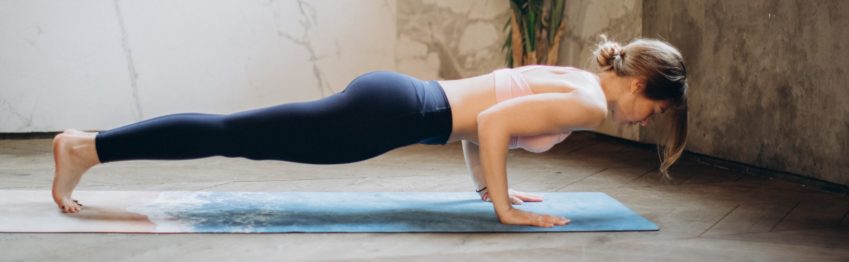
The benefit of this exercise is it conditions the abdominals in tandem with the lower back musculature, and trains the abs to resist the hip flexor muscles as they try to extend the low back during the set.
If you do a plank and feel your low back arch coupled with discomfort in that area as lactic acid builds up, I’d suggest you end the set as your TVA is fatigued and you’re just training the hip flexors now.
You might like to start by watching this excellent video:
I use this exercise a lot with many of my clients as it’s simply a great core, trunk and glute exercise.
If you feel your backside burning during the exercise then congratulations! It means you’re doing it correctly.
If you feel it in your low back then it’s possible you’re not activating your TVA, or you’ve fatigued it and it’s time to stop the set.
Another great video to start with. This is 15-minutes long, so get comfortable…
This exercise is like a dynamic plank as you use your entire trunk to stabilise the spine and maintain good posture and form.
Plus the use of a Swiss Ball means your stabiliser muscles are engaged to help you balance on the unstable ball.
This is a more advanced exercise and requires some upper body strength in order to be able to perform it safely. Do not attempt this exercise until advised to do so by your trainer!
The following short video will help:
The Swiss Ball Crunch is superior to the sit-up because:
1. It trains the abs through a full range of motion.
2. You have to use your core muscles to stabilise you when you are using it; an added bonus (trust me on this one).
3. You strengthen your neck in tandem with your upper abs and maintain the strength balance between them.
4. If you do the exercise correctly you can train the lower and upper abs at the same time.
Another short video will help:
GOOD HEALTH IS MORE IMPORTANT THAN A 6-PACK
As far as I’m concerned spinal health, longevity and integrity are far more important that ‘6-pack’ abs, and I make that comment having helped more than one client who had ‘6-pack’ abs and also had low back pain.
Appearance is no guarantee of skill, ability or function. You may look the part, though that’s where it ends.
Sets and reps for abs: Abs are made up of the same muscle fibres you have in the other major muscle groups of your body, and I suggest training them in the same style.
High reps will merely train them for muscle endurance, which is great if that is what you want.
Using those high reps won’t strip fat from around the abs (as I mentioned earlier in my post), so sticking to sets of 8-10 is a good idea as they’ll be conditioned in the same rep range as the rest of your body.
Also, consider that when you perform free weight exercises, your abs are actually involved in stabilising and protecting the spine during lifting. So they get a good workout (albeit indirectly) whenever you lift weights and when you run or do anything dynamic if fact.
Your abs play an integral part in stabilising the spine during your workouts, whether that is a weights or cardio workout. If you train them at the start of a workout you weaken them, so they may not be able to protect your lower back enough during the session. As a result, you may get injured. This is why doing abs last in your workout is a wise idea.
Health and Happiness (and keeping the spine as healthy as possible for as long as possible),
Cris


Cristian Ramis
RAMIS Health & Fitness, Westcliff near Southend-on-Sea
Gold Directory Listing Find out more about RAMIS Health & Fitness
Image credits:
Header image by Jonathan Borba from Pexels
2 Comments
[…] don’t do crunches and sit-ups as these encourage poor posture and potentially add to or help create lower back pain and disc […]
[…] If going to the gym is your thing, ensure you know how to use the equipment properly and do not do sit-ups and crunches which can potentially cause long-term damage to the spine. […]