
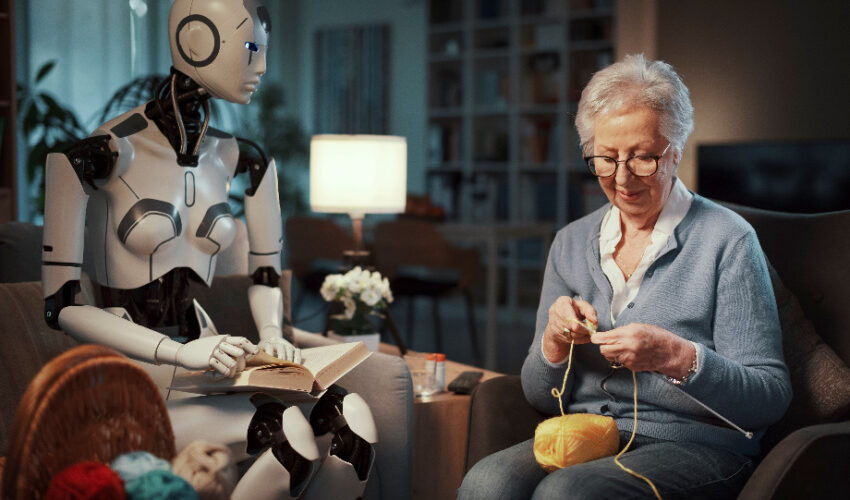
Revolutionising Elderly Care: How AI and Robotics Could Transform Senior Living
Japan has long been interested in robotics. As they are one of the (many) countries with a top-heavy ageing population, the rest of the world is watching their experiments with interest. Could AI and robotics transform elderly care?
If Japan’s experiments evidence viable solutions with AI and robots as a stand-in to support the ageing population, not only could this make life so much better for many older people, it could also provide a solution to a UK social care system in crisis.
The advent of ever more advanced AI teamed up with ever more capable humanoid robots seems to hold a lot of promise – a promise that is more urgently required than ever before, especially with the addition of a huge base of Long Covid patients moving from the pool of potential carers to the pool of those requiring assistance.
Let’s take a look at how AI and robotics can transform an older person’s life, whether they are still living in their own home, or residing at cosy care home such as Eastleigh care homes in Somerset.
Robots Are ‘Always Available’
A robot companion can be powered on for twenty-four hours a day, complete double and even triple shifts, and not mind being ‘woken up’ in the middle of the night for a chat or to deliver medications. This can be an immense help to care homes where staff are often stretched thin.
Robots Can Be Excellent Companions
A robot is just a computerised hunk of metal, but people have an in-built urge to anthropomorphise things – how often have you spoken supportively to your glitching computer or stuttering car to give it encouragement to run properly?
Faced with a robot with a face and a voice – an active attempt to simulate a person – many people quickly adapt to treating the robot as a companion rather than a tool. And for many old people simply having ‘someone’ to talk to and interact with can help to stave off feelings of loneliness and isolation, as well as halt some signs of cognitive decline.
Robots Can Alert Emergency Services
A robot companion can also operate as a middle man between the elderly person and the outside world, being programmed to alert the emergency services should their owner-operator fall ill or fail to respond to check-ins. This can give peace of mind to independent folks who are resisting the move to a care home, but understand that they are not quite as capable as they once were. It is also reassuring to family members who can relax, knowing that they will be promptly summoned should anything untoward occur to their loved one.
Robots Can Help With Mobility
Robots can also work like a sort of sentient Zimmer frame, helping their charges to move from bed to living room to kitchen and back again, providing a sturdy support, lifting and carrying heavy items, and generally lending a hand with day-to-day tasks.
While this sounds amazing, we are not quite there yet. Japan has automated a great number of tasks, but uptake on robot companions has been slow. This is because often the time saved by having the robot perform certain tasks is taken up instead by caring for the machine.
But as the technology continues to advance, there will come a point when AI-driven robots do take their rightful place in society and this certainly could begin with improvements in senior living.
Although to many this still seems more like fiction than reality, technology is moving at such as fast pace that perhaps in less than a few years the experiments in Japan will show that AI and Robotics really could transform elderly care and ease the pressure on our troubled NHS.