

Are Addiction Rates in Essex Higher Than the National Average?
Addiction is something every community has to face. Drug misuse in Essex is no exception. Across England, government data shows that 310,863 adults were supported by drug and alcohol services in 2023-2024.
What the data doesn’t tell us is that behind every statistic is a person. And with them a family and a story that often goes unheard. Then, there are the ones not counted, in other words, the ones still suffering from their addictions and not seeking help.
Essex has its own story to tell. Some areas see higher hospital admissions for alcohol. Others struggle more with drug-related harm. But are addiction rates in Essex actually higher than the national average?
Yes and no. It depends on where in Essex you go. And the places you go also determine what type of addictions you’re likely to see.
The numbers are what they are. The more important thing is the help that’s available. For those ready to take that step, PCP Chelmsford Rehab offers specialist support right here in the county, giving people a local place to turn when things feel overwhelming.
Drug Misuse: the National Picture
Drug and alcohol misuse and addiction don’t fall evenly across the country, with some regions experiencing significantly higher rates than others. In some situations, reduced access to recovery services may occur, and in others, long-standing community health issues can increase risks. But even with these differences, there are trends.
Alcohol-related harm is a significant concern, with hospital admissions rising year on year. Deaths linked directly to alcohol are at their highest levels. Drug-related issues show a similar pattern. More people are seeking treatment for opiates, crack cocaine and, increasingly, substances like ketamine.
What’s striking is that addiction isn’t just a “big city” problem. It affects coastal towns, rural areas and commuter counties too.
Essex by Numbers – How Does the County Compare?
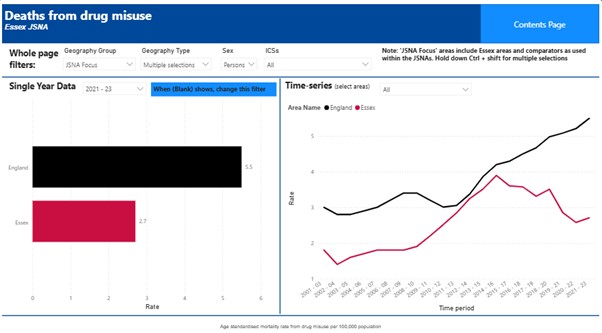
While national concern around drug-related deaths has grown in recent years, Essex has reported consistently lower rates than the England average. According to local health data, between 2021 and 2023, the mortality rate from drug misuse in Essex was 2.7 per 100,000. This compares to 5.5 per 100,000 across England.
Essex, as shown in the chart, has generally maintained lower rates over time. Even as national figures have risen. There’s a notable divergence in 2016, too. England’s trend continued upward, while Essex began to decline.
Source: https://data.essex.gov.uk/dataset/jsna-health-behaviours-alcohol-and-drug-use-dashboard-2owdn
This data suggests that while Essex isn’t immune to drug misuse, its mortality impact is statistically lower than the average. That said, it still represents a significant public health issue. And it’s one that requires ongoing intervention, particularly in high-risk districts like Southend-on-Sea.
Why Might Essex Face Different Addiction Pressures?
Essex has a diverse geography with rural villages, coastal retreats, affluent commuter towns and deprived urban areas – which means needs differ across areas.
Coastal deprivation is huge. Clacton, Jaywick and Harwich have struggled with poor health outcomes, limited employment opportunities and higher levels of isolation. These are all recognised risk factors for addiction.
Commuter belts like Brentwood and Chelmsford, on the other hand, have a higher trend of alcohol consumption among professionals. This misuse is more stress-related, and the addiction is often hidden. There are frequently issues that don’t reach treatment services until much later.
Young people also face mental health challenges here. Anxiety, poor housing affordability and disrupted access to youth services create an environment that lends itself more to drug experimentation.
When you understand the local pressures the region has, you can see why the addiction profile looks the way it does. And it shows us the importance of district-level solutions, rather than regional or national ones.
What Access to Local Support Essex Offers
There is a broad range of support offered in Essex, though this varies by district. Essex Wellbeing Service, Open Road and NHS substance misuse teams work to support those suffering from addictions. There are assessments, detox pathways, harm reduction and community support available.
Chelmsford, Basildon and Southend have some of the most active treatment hubs. They serve large populations with diverse needs. The services have structured support with CBT, group therapy, relapse prevention and family interventions.
Like many parts of England, though, Essex faces challenges:
- Long waiting lists.
- Patchy availability of specialist young person services.
- Pressures on mental health support that affect addiction treatment.
- Travel barriers for residents in rural or coastal locations.
Private and third-sector providers complement the local offer. Whether through NHS or independent routes, Essex residents do have options. But demand is high, and early help is crucial.
Public Attitudes, Awareness and Stigma in Essex
Even with services available, stigma is a big barrier in Essex, as it is elsewhere in the country. In smaller and coastal communities where “everyone knows everyone,” the fear of being judged is especially strong.
Stigma makes addiction seem like a moral failure, not the health condition that it is. This causes individuals to be secretive, feel shame and not seek treatment, all of which worsen outcomes. This is particularly visible in the older adult population, those who have lived with alcohol dependency for many years but have never sought formal support.
Families also absorb pressure. Partners, parents and children sometimes hide the addiction too. It all creates isolation instead of what’s needed.
Local organisations are trying. Awareness campaigns, peer networks and recovery groups are making it easier for people in Essex to speak openly and get help sooner.
What Needs to Happen Next in Essex?
Investment and community awareness are needed, with key priorities being:
- Work to improve early intervention. This is particularly pertinent for high-risk districts.
- Increasing access to youth and mental health services.
- Reducing waiting times through better funding.
- Expanding outreach in rural and coastal areas.
- Tackling stigma through education and visible recovery stories.
Importantly, Essex already has strong foundations. Experienced treatment providers, active voluntary organisations and local authorities are committed to reducing harm.
Conclusion
So, are addiction rates in Essex higher than the national average? In some areas, yes. But Essex is not alone. Many regions face similar pressures and drug-misuse in Essex is not unique by any stretch of the imagination
What matters most is that help is available. No matter your situation, there is help available.